See What Becomes Visible When You Map Material Movement
Structured, high-resolution data for your food safety team and your AI agents.
Get StartedFrom Assumptions to Evidence
Made from inactive baker's yeast, BioTags are DNA-labeled microbial tracers that allow food safety professionals to simulate contamination — without disrupting production.
With 100,000x more detectable data per gram, BioTags give your food safety team high-resolution visibility into how material moves, persists, and is removed — clear baselines, actionable trends, and data you can compare across facilities. And when you layer in AI, that same data becomes the foundation for predictive intelligence.
Get Started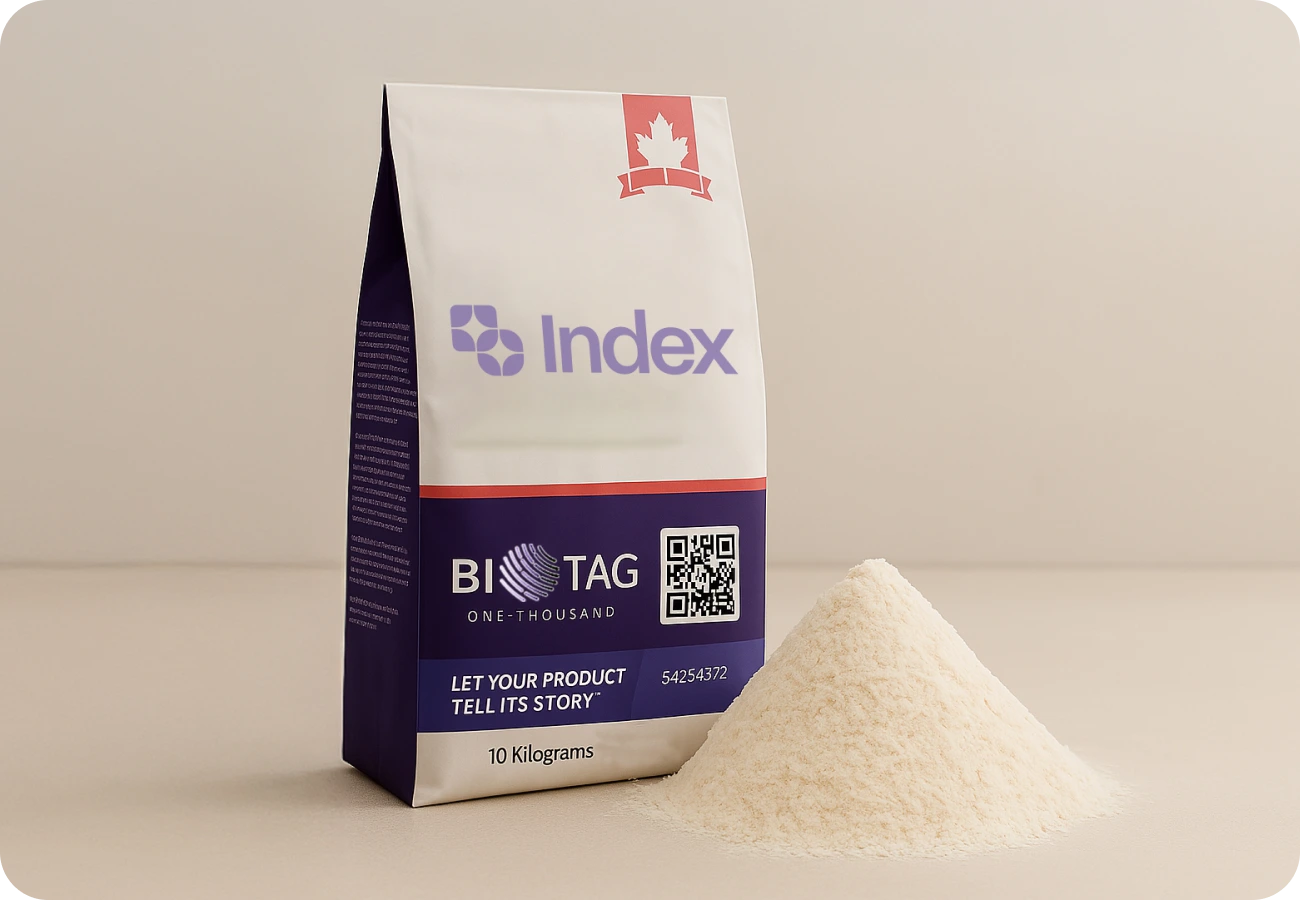
Safe
US FDA and Health Canada compliant. NO gene modification. NO labeling requirements.
Versatile
Works with dry, liquid, and ingredient-based food systems.
Invisible & Inert
Applied at trace levels (ppm). Fully inactivated. No impact on taste or texture.
Customizable & Scalable
Track multiple unique "breadcrumb trails" simultaneously, enabling holistic, facility-wide analysis.
Measurable & Standardized
Benchmark, compare, and harmonize data across testing types and multiple facilities.
Better data changes three decisions your team makes every day: release, investigation, and changeover.
BioTags give your team structured, high-resolution evidence to rethink the decisions that drive cost and risk — fewer precautionary holds on borderline results, shorter investigation cycles with clear baselines to work from, and tighter changeover protocols backed by quantitative proof rather than assumptions.
This same data quality is what makes AI possible. Agents on Trailhead use BioTag data to predict rather than react — identifying patterns across facilities that no conventional dataset could reveal.
See the PlatformTHE TOOLING GAP
What Changes When You Add BioTags?
FSQA teams work with tools at two extremes. Hygiene verification confirms a surface is clean at a single point -- but doesn't show where material went. Pathogen and allergen testing confirms a failure occurred -- but only after the fact. Between these endpoints, there hasn't been a tool that quantitatively simulates how material moves, persists, and is removed. That's a tooling gap, not a people gap. BioTags fill it.
Proactive Contamination Mapping
Map how material moves through your facility before problems occur -- not after.
Quantitative Data
Know exactly how much material is present and where -- not just whether it was detected.
Defensible Release Decisions
Quantitative thresholds that reduce ambiguity -- evidence-backed decisions, not gut calls.
Faster Investigations
Clear baselines help investigations close faster with defensible conclusions.
BioTags in Action
From sanitation verification to contamination mapping — BioTags give your food safety team the data they need to make better decisions, faster. And when you're ready for AI, that same data supercharges your agents.
The Challenge
The FDA's latest Preventive Controls Guidance highlights the need for validated sanitation programs and proactive monitoring to prevent cross-contamination.
How BioTags Help
BioTags provide clear, measurable proof that clean breaks and flush-outs are effective — without interrupting production. Advanced analytics reveal patterns that drive operational efficiency. Teams who can quantify effectiveness often find room to tighten changeover buffers without adding risk.
The Challenge
Traditional sanitation checks are reactive — like searching for a needle in a haystack. Not detecting contamination doesn't mean it's not there.
How BioTags Help
Applied before cleaning, BioTags establish clear baselines. PCR analysis quantifies how much BioTag material remains after sanitation -- providing a correlatable proxy for cleaning effectiveness and pinpointing vulnerable areas. When investigations do happen, clear baselines mean faster closure with defensible conclusions.
The Challenge
Pathogenic events are rare — traditional monitoring leaves too few data points to predict how contamination moves through your facility.
How BioTags Help
Apply multiple unique BioTags at key vulnerability points to create customizable breadcrumb trails. Trace contamination flow under normal operating conditions — no process changes required. Knowing where contamination moves means fewer precautionary responses when events do occur.
The Challenge
Thermal processes like blanching, roasting, and baking are critical control points — but once validated, they often run unchecked for drift until a problem arises.
How BioTags Help
Processing conditions — temperature, pH, chemical exposure — have consistent, correlatable impacts on BioTag detectability. Once that pattern is established, BioTags serve as a lower-burden verification tool — providing directional evidence of process performance between full surrogate revalidations. The payoff: extend the interval between costly, disruptive surrogate studies without losing visibility into thermal performance.
The Challenge
Traditional traceability methods rely on paper records and manual processes that can't always prove where a product has been or hasn't been.
How BioTags Help
Apply unique BioTag identifiers at every critical step — generating structured, traceable evidence of product journey from raw materials to finished goods.
One Tool. Multiple Applications.
Lower-Risk, Cost-Saving Insights
- Consider the holds, investigation hours, and sanitation buffers your facility absorbs today — even modest improvements change the economics.
- BioTags generate the evidence to question assumptions your team has been operating under.
Reliable & Versatile Data
- Homogeneous application ensures consistent, repeatable results.
- Works seamlessly in wet and dry manufacturing environments.
No Live Culturing Required
- No live pathogen or surrogate handling required.
- Safer, simpler compliance — no live organism handling.
Seamlessly Integrated
- Integrates into existing workflows — no process modifications required.
- Scalable for any facility size.
One Tool, Multiple Applications
- Fully traceable from application to finished product.
- Applicable across ingredients, surfaces, and equipment.
AI-Driven Predictive Intelligence
- Power AI models with predictable, high-quality datasets.
- Standardize insights across multiple facilities.
BioTags + Trailhead
Now Add AI Agents to the Mix
BioTags are powerful on their own — but when you connect them to the Trailhead AI platform, the data they generate becomes the foundation for predictive intelligence. Environmental monitoring data and AI have always been a poor fit. BioTags are what finally make that combination work.
Agents on Trailhead ingest BioTag data alongside your existing testing results, map contamination pathways, build predictive models, and surface risks your team would never catch manually. The same data your food safety team relies on — now working for AI agents around the clock.
Explore Trailhead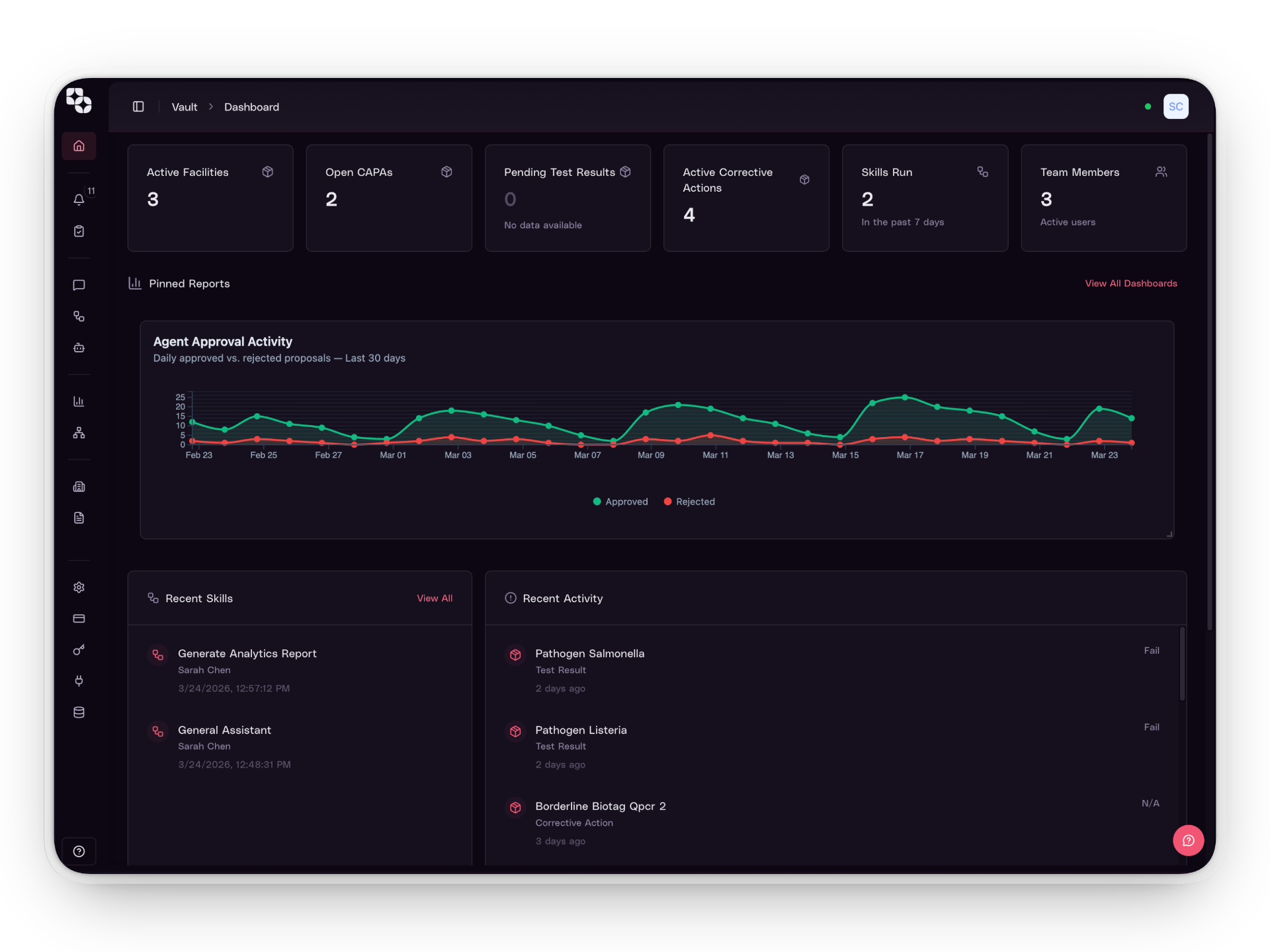
How BioTags Work
A simple four-step process — from application to AI-powered insights.

Application
Introduce BioTags at trace levels (ppm) onto ingredients, surfaces, or equipment.

Sampling
Collect swabs or retained product samples before and after interventions.

Testing
Analysis uses industry-standard PCR methods.

Reporting
AI agents on Trailhead transform BioTag data into actionable, predictive insights.
Case Study
Creating a Molecular-Level Digital Twin in Flour Milling
Request Case Study"The insights from our project with Index are poised to establish new best practices for the industry. This technology allows us to understand the risk and manage it in our operations more precisely."

What would your programme look like if every decision had evidence behind it?
Release decisions, investigation cycles, changeover protocols — these are the moments where better data compounds into real value. BioTags give your team the evidence to make each one with confidence.
Get Started