What We’ve Learned From 100+ Conversations
Over the past year, I have spoken with more than 100 mid-market and enterprise stakeholders evaluating agentic AI. Across those conversations, one pattern has become increasingly clear: interest is high, but executive understanding of what will actually determine success is still uneven. Many organizations are exploring pilots, platforms, and internal use cases. Far fewer have developed a clear view of how to move at the speed this market now demands without creating brittle systems, fragmented operating models, or avoidable lock-in.
The environment is moving unusually quickly. Frontier models continue to improve at a remarkable pace, and the surrounding ecosystem is evolving just as fast. Application-layer companies are iterating rapidly. New orchestration patterns are emerging. Enterprise controls are beginning to mature. Taken together, these shifts are reshaping how food safety work is executed and how operational leverage is created.
For food safety leaders, the challenge has moved past adoption. The real value is the ability to progressively operationalize new capabilities without constantly re-architecting the enterprise. That is why partnership quality matters so much. Vendor selection has become a strategic decision about which partner can help the organization move quickly, preserve optionality, and build toward governable autonomy.
What follows reflects the advice I would offer executive teams based on those conversations.
1. The Pace of Change Is an Operating Condition
AI is now evolving quickly enough that static assumptions degrade faster than most enterprises expect. That is true at the model layer, but also at the systems layer: retrieval, tool use, memory, orchestration, evaluation, and interface design are all improving in parallel. Capabilities and best practices can shift materially within a few quarters.
That has significant implications for planning. Procurement models, technical roadmaps, and vendor decisions built for slower-moving categories are under pressure. Leadership teams should plan accordingly. Speed has become an order qualifier, not a luxury.
2. Innovation Is About Adaptation
Competitive advantage is likely to come from the ability to evaluate new capability, incorporate it into food safety workflows, and translate it into operational benefit faster than peers. Access to advanced models is becoming widely available. What separates winners is whether the organization can repeatedly convert technical progress into better decisions, faster execution, and more effective FSQA programs.
That conversion requires more than technical talent. It depends on product judgment, process redesign, and the ability to learn across functions. It also depends on whether the organization has partners capable of extending its speed and judgment where internal execution would otherwise lag.
3. Founder-Led Companies Have Structural Advantages
In many cases, founder-led companies are better aligned to the pace, ambition, and willingness to re-architect required to remain near the frontier. Large incumbents often face structural friction created by installed-base economics, organizational complexity, and slower decision-making.
This matters directly for FSQA buyers. The same forces slowing incumbents are often present inside the organizations evaluating them. Leadership teams should pay close attention to how a vendor makes decisions, how quickly it improves its product, and whether its business model supports continued reinvention.
4. Optionality Is a Strategic Principle
The organizations making the best decisions today are learning quickly without overcommitting. In a market where models, tooling, and control patterns are still evolving, optionality has real strategic value.
That usually points toward modular architecture, portable data, observable workflows, and a clear separation between business logic and model dependencies. A vendor that makes portability difficult may be signaling more than a product choice. A vendor that assumes it must win by staying ahead, rather than by increasing switching costs, often has a healthier posture for a market like this one.
5. Near-Term Value Sits in Workflow Automation
There is understandable excitement around autonomous agents, but most enterprise value today is still being created in more bounded settings. In food safety, that means:
- Environmental monitoring analysis — trending swab data, flagging patterns, generating reports
- Corrective action management — drafting CAPAs, routing approvals, tracking completion
- Audit preparation — assembling documentation, cross-referencing records, identifying gaps
- Supplier document management — ingesting COAs, verifying specs, managing qualifications
- Deviation triage — classifying events, assessing severity, routing to the right team
These use cases are often less dramatic than visions of broad autonomy, but they tend to be more economically tractable and easier to govern.
At Index Bio, we frame this as the progression from Assist (AI helps your team) to Automate (AI executes defined workflows) to Delegate (AI handles end-to-end processes with human oversight). An 80/20 distribution across workflow automation and more autonomous pilots is a sensible starting posture.
6. Governance and Change Management Deserve Executive Attention
A large share of enterprise disappointment in AI has less to do with the quality of the models than with the readiness of the organization using them. Governance is often too loosely defined. Internal ownership is fragmented. Employees are introduced to new systems without enough support or clarity around accountability.
Over time, effective agent management is likely to depend on a new kind of operator: highly technical, broadly capable, and deeply embedded in the organization’s context. In food safety, these individuals will need to orchestrate agents, validate outputs against regulatory requirements, resolve ambiguity, and connect system behavior back to real operational constraints.
7. Architecture Determines Whether AI Compounds or Fragments
A well-designed product architecture makes governance easier, change more manageable, and institutional learning easier to preserve. Weak architecture tends to produce disconnected assistants, brittle workflows, inconsistent controls, and growing uncertainty about how decisions are being made.
This problem often appears gradually. A team launches a pilot. Another group adopts a separate tool. Prompts and workflows accumulate locally. What looked like experimentation eventually turns into operational sprawl. Good architecture creates a durable substrate for governance, training, and scale.
8. Enterprises Need More Than One Agent Surface
One of the more limiting assumptions in the market is that AI will be delivered through a single interface — usually chat. In practice, food safety work is too varied for that. Some tasks benefit from conversational interfaces. Others require a stable workflow with predictable steps. Still others involve cross-system coordination where autonomy becomes useful.
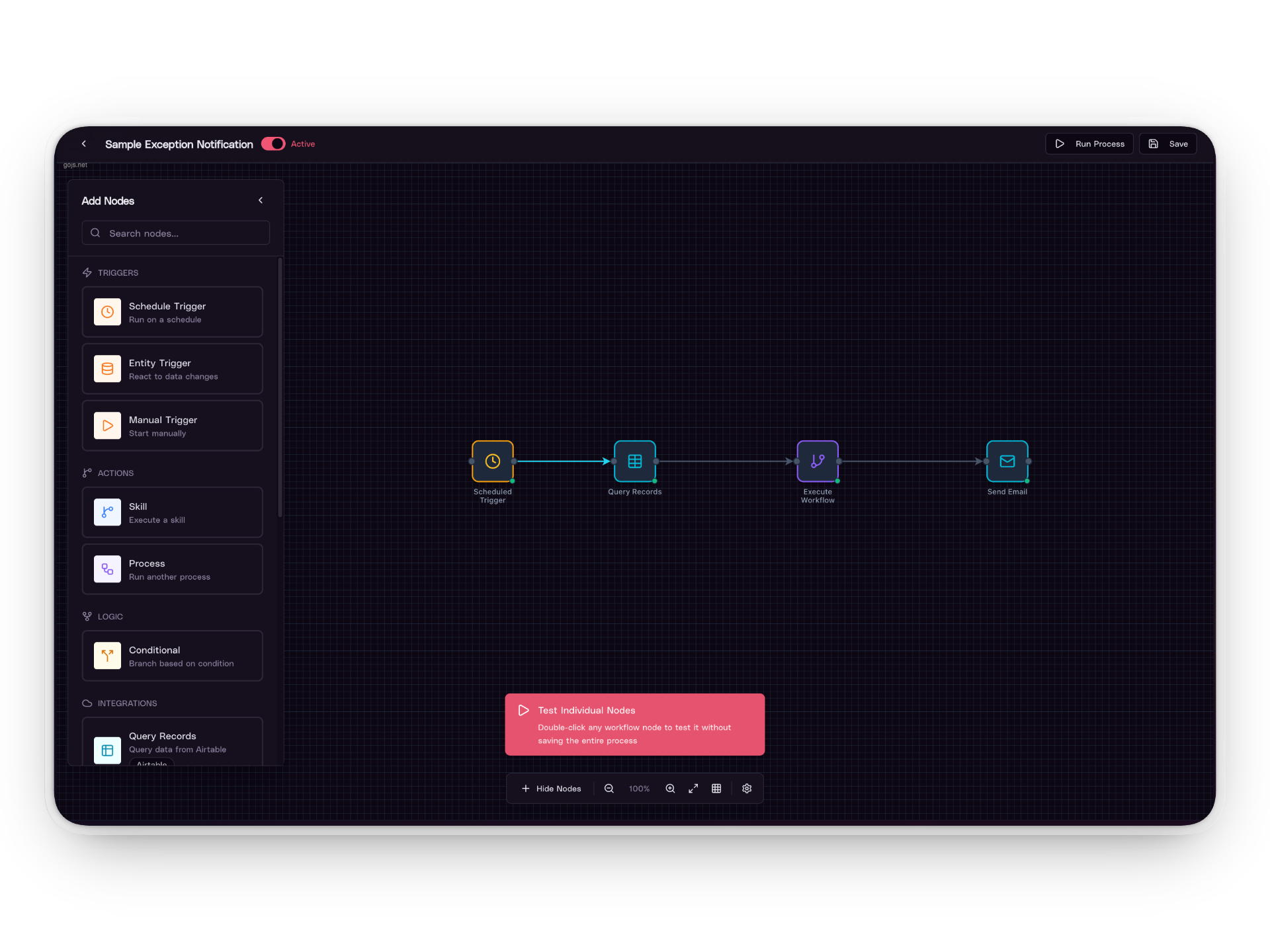
Mature environments are likely to expose several surfaces at once. At Index, we’ve built this into the platform: Assist provides the conversational interface, Automate delivers consistent workflow execution, and Delegate enables autonomous cross-functional processes. These aren’t separate products — they’re connected operating modes.
9. Context Delivery Is Where Systems Fail
Data quality still matters. So do permissions, lineage, and integration coverage. Yet even strong data does not automatically produce strong agents. What frequently breaks down is context delivery. Agents need access to the right information, in the right format, with the right constraints, at the right point in a workflow.
This is where vendor capability becomes highly visible. Serious vendors should offer strong off-the-shelf integrations with LIMS, ERP, and QMS systems, and be able to build custom integrations quickly. They should treat data engineering and context management as core product capabilities, not implementation details.
10. Reliability Is a Function of Harness Design
Even with strong data and capable models, dependable enterprise performance has to be engineered. Agents need constraints, routing, validation, memory policy, approval logic, and escalation frameworks. They need to operate inside clear boundaries.
In food safety, this is especially critical. A 95% accurate model isn’t a success story — it’s a liability. The 5% error rate means missed deviations, incorrect COAs, or flawed corrective actions. Consistency comes from the surrounding system: how tasks are decomposed, how context is assembled, how actions are checked, and how exceptions are handled.
The Path Forward
Executive teams should approach agentic AI with urgency, but not with false certainty. Choosing the right partner to build with matters more than the adoption decision itself. The right partner helps an organization move faster than its native operating model would otherwise allow.
Over time, the companies that distinguish themselves will not be the ones that adopted the most tools. They will be the ones that selected partners wisely, preserved optionality, and turned rapid external progress into durable internal advantage.