The Misconception
There’s a persistent belief in enterprise AI: that smarter models alone will solve your reliability problems. In food safety, where the cost of errors is measured in recalls, regulatory action, and consumer harm, this belief is not just wrong — it’s dangerous.
A 95% accurate model isn’t a success in food safety. It’s a liability. The 5% error rate means missed deviations, incorrect COAs, flawed corrective actions, or inaccurate environmental monitoring reports. In an industry where errors cascade into holds, recalls, and regulatory scrutiny, “almost right” is unacceptable.
That’s why we don’t rely on model capability alone. We practice what we call harness engineering — wrapping advanced AI models in a rigid, programmable safety layer that transforms probabilistic outputs into deterministic operational performance.
Think of it this way: the model is the engine. The harness is the chassis, the transmission, and the brakes.
Three Core Principles
1. Context as Compiler
Most AI systems treat context like a chat transcript — a rolling window of recent interactions. That works for casual conversation. It fails for food safety operations.
Our harness compiles focused runtime environments for each task. When an agent analyzes environmental monitoring data, it doesn’t get a dump of everything. It gets precisely the data it needs: the relevant swab results, the facility zone map, the historical trend for that sampling point, and the applicable limits. Working memory is separated from system-of-record context, preventing confusion during complex, multi-step workflows.
This is especially critical when agents are processing months of environmental data or cross-referencing results across multiple facility zones. Without disciplined context management, agents lose track of what they’re doing and why.
2. Anti-Hallucination Layer
In food safety, invented data isn’t just wrong — it’s dangerous. A hallucinated test result or a fabricated corrective action record could trigger incorrect decisions with real consequences.
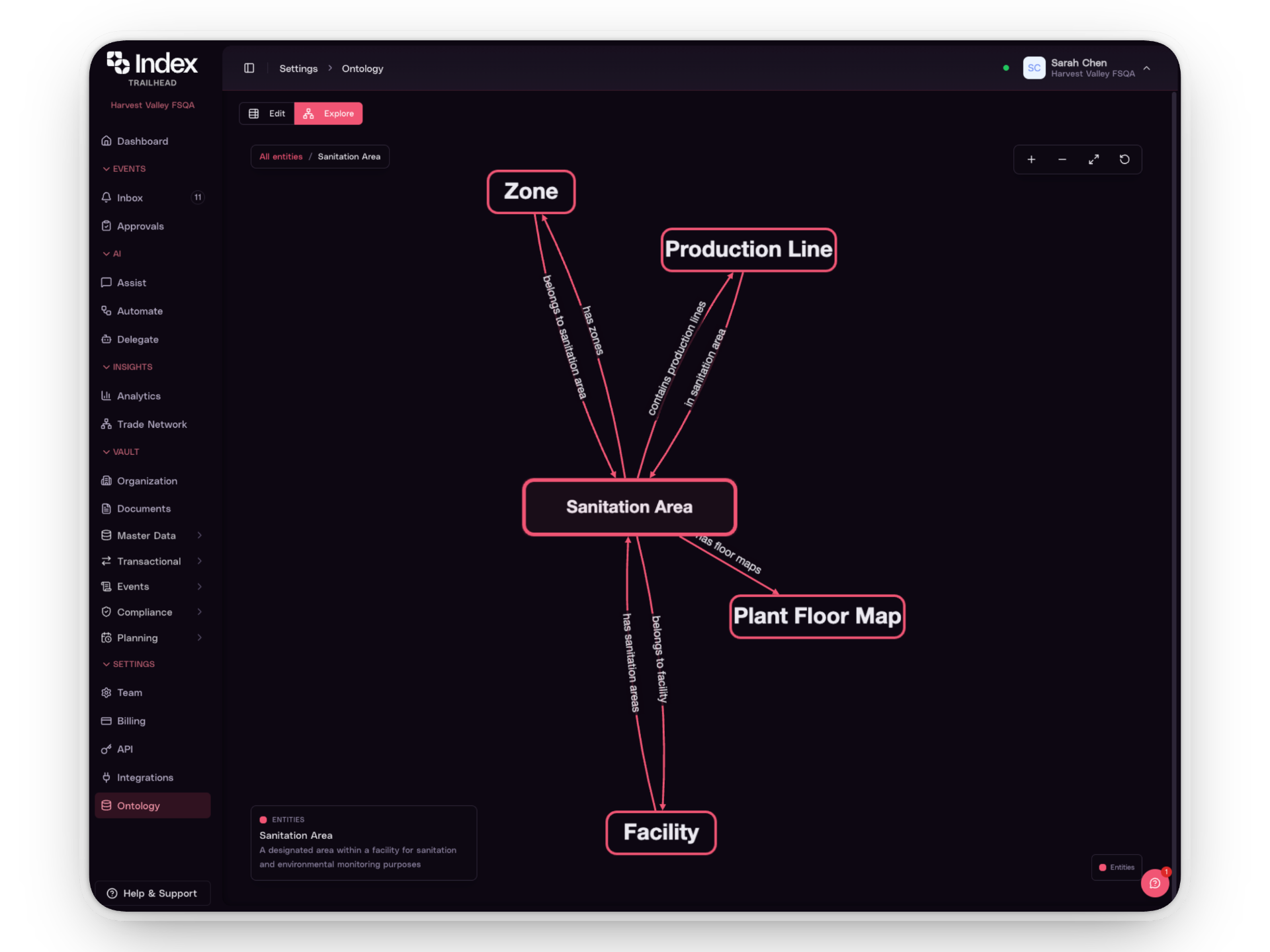
Our business ontology creates a strict mapping of operational reality. Every entity in your food safety world — sampling points, test methods, specifications, suppliers, products, zones — is defined in a structured knowledge graph. If a field isn’t in the document or the ontology, the harness architecturally blocks the agent from making it up.
This isn’t prompt engineering. It’s a structural constraint. The agent physically cannot generate data that doesn’t exist in its authorized sources. When parsing a COA, it extracts what’s there. When it encounters missing data, it flags it rather than filling in the blank.
3. Tiered Memory and System Integration
Food safety data lives everywhere — in LIMS, ERP, QMS, email, PDFs, supplier portals, and spreadsheets. The harness ingests unstructured data from all these sources while verifying outputs against your existing systems of record.
This means agents can:
- Parse incoming supplier COAs and extract structured data
- Cross-reference results against product specifications in your LIMS
- Draft corrective actions that reference actual historical records
- Generate reports that pull from verified, auditable data sources
The harness doesn’t replace your core systems. It connects them intelligently, ensuring that every AI-generated output is grounded in your actual operational data.
Governance by Design
High-stakes actions in food safety require human oversight. The harness enforces this through approval gates at configurable thresholds:
- Routine outputs (trend reports, data summaries) flow automatically
- Significant actions (corrective action drafts, deviation classifications) require review
- Critical decisions (product holds, supplier disqualifications) require explicit approval
Every action is logged with a full audit trail — who authorized it, what data informed it, and what the agent’s reasoning was. SOC 2-compliant. Auditor-ready.
Why This Matters
The food safety software market is full of vendors claiming “AI-powered.” Most are running prompts against a language model and hoping for the best. That works in a demo. It fails in production.
Harness engineering is what separates a demo from a system you’d trust with your food safety program. It’s the difference between AI that sometimes gets it right and AI that performs reliably, every time, with full traceability.